Can My Teeth Be Saved? How I Decide Between Saving and Removing a Tooth

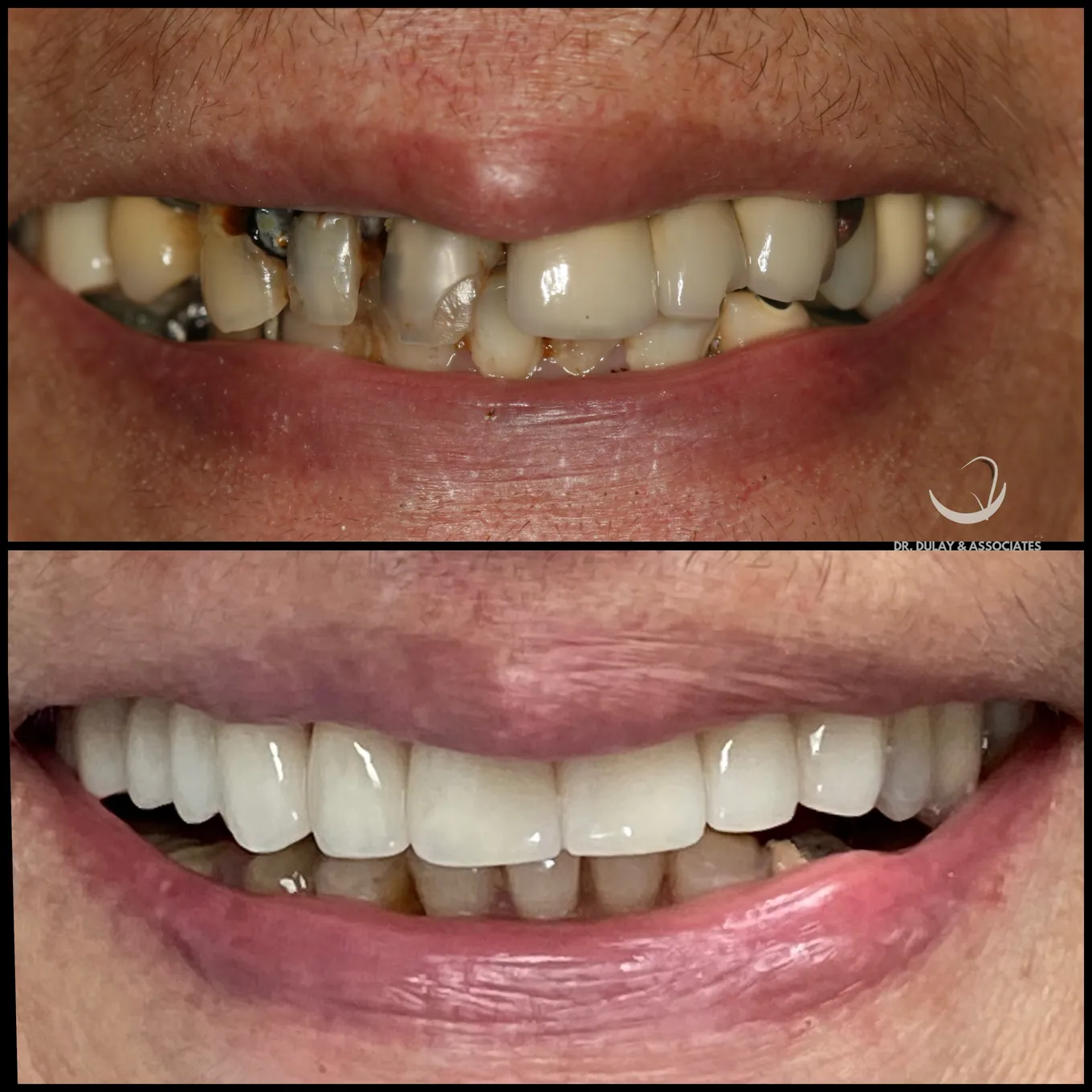
Before and after: broken, decayed upper teeth restored, every tooth kept by Dr. Rajvinder Dulay- Tamarac FL.

Maybe you’ve been told a tooth has to come out. Maybe you’ve looked at a mouth full of broken, dark, patched teeth and assumed the only answer left is dentures or implants. Either way, removing a tooth is the one dental decision that can’t be undone.

The short answer: often, yes. A tooth can usually be saved when three things are true: enough healthy tooth is left after the decay is removed to seal a restoration to, the root and the bone around it are sound, and any nerve problem can be treated with a root canal.

It usually can’t be saved when the root is cracked, the decay runs below the bone, or the bone support is gone.

What a tooth looks like tells you surprisingly little. Some teeth that look hopeless have strong roots and plenty of sound structure underneath. Some that look fine are cracked to the root. The decision is made below the surface: on X-rays, and once the decay is out.

What decides whether a tooth can be saved

1. How much healthy tooth is left

Decay is removed first. What matters is what remains: enough sound tooth, especially at the edges near the gum, for a new restoration to seal against. If the edges can be sealed, decay has nowhere to get back in. If they can’t, a restoration will fail no matter how well it’s made.

2. The nerve

When decay reaches the nerve, the nerve becomes inflamed or infected. That isn’t a reason to remove the tooth. A root canal cleans out the inside of the tooth and seals it. I do most of my root canals myself and refer the complex ones to an endodontist. A tooth that has had a root canal then needs a restoration that protects it.

3. The root and the bone

A strong root in healthy bone is what makes a tooth worth rebuilding. A root that’s cracked lengthwise can’t be repaired. Severe bone loss from gum disease can leave a tooth too loose to support anything. These are the two most common reasons a tooth truly has to go.

4. The rest of your mouth, and what you want

One tooth is never decided alone. How it fits in your bite, what the teeth around it need, and what you want, including whether you want to avoid surgery, all shape the plan.

Why saving a tooth is worth the effort

An implant is a good replacement. It is still a replacement. Removing a tooth and placing an implant means surgery, healing time and more steps. A natural tooth keeps its own root and the ligament that cushions it in the bone.

Saving a tooth also means choosing how to rebuild it. Where I can, I use an inlay or onlay, which replaces only what’s missing, instead of a crown, which needs the whole tooth shaped down. Keeping more of the tooth is the point.

Teeth that were saved, from least to most damaged

Every tooth below was a candidate for extraction by appearance alone. Each was kept.

A small spot over deep decay

Biting surface of a lower molar with one small dark spot in the groove.Before
The same molar restored with a tooth-colored ceramic restoration.Saved
From the surface, one small dark spot. Underneath, the decay had reached the nerve. Saved with a root canal and a ceramic restoration. Actual patient of Dr. Dulay & Associates, published with consent. Individual results vary.

Decay close to the nerve

Upper molar with a cavity broken open between the teeth, exposing dark decay.Before
The same molar after a root canal and a ceramic restoration.Saved
The cavity had worked in from between the teeth until it sat against the nerve. Saved with a root canal and a ceramic restoration. Actual patient of Dr. Dulay & Associates, published with consent. Individual results vary.

Decay hiding under an old silver filling

Lower molar with a large old silver filling that looks intact.Before
The same molar after the old filling and decay were removed and the tooth was rebuilt in ceramic.Saved
The old filling looked intact. Underneath it, decay had spread through the tooth. The filling and decay were removed and the tooth rebuilt in ceramic. Actual patient of Dr. Dulay & Associates, published with consent. Individual results vary.

Half the tooth broken away

Upper molar with a large part of the side broken away and brown decay exposed.Before
The same molar restored with a ceramic onlay.Saved
A large part of the tooth had broken off around decay. After a root canal, it was rebuilt with an onlay rather than a crown, which kept more of the natural tooth. Actual patient of Dr. Dulay & Associates, published with consent. Individual results vary.

Decayed down to the gumline

Lower molar with decay that has broken away the back of the tooth down to the gum.Before
The same molar after a root canal and restoration.Saved
Decay had destroyed the back wall of this tooth down to the gum. Actual patient of Dr. Dulay & Associates, published with consent. Individual results vary.
Upper molar with most of its biting surface destroyed by decay.Before
The same molar restored after a root canal.Saved
Most of the biting surface was gone. In both teeth, the roots and bone were sound and the edges could be sealed, so both were saved with a root canal and restoration. Actual patient of Dr. Dulay & Associates, published with consent. Individual results vary.

Save it, or take it out and place an implant?

Lower molar after decay removal, with the inside of the tooth rebuilt and sound walls remaining.Before
The same molar restored with a ceramic inlay.Saved
The tooth after the decay was removed, and the finished e.max ceramic inlay. Actual patient of Dr. Dulay & Associates, published with consent. Individual results vary.
X-ray of the saved molar after its root canal, with an implant replacing the missing tooth beside it.X-ray
The finished root canal, with the implant that replaced the patient’s missing tooth next to it.

This patient had already lost the tooth next to this one, and it had been replaced with an implant. When this tooth needed treatment, extraction and a second implant was an option. The patient didn’t want another surgery and didn’t want to lose another natural tooth.

After the decay was removed, enough healthy tooth was left to seal the edges of a ceramic inlay, and the roots and bone were strong. So I saved it: a root canal, then an e.max inlay.

A whole upper arch, every tooth kept

Smile showing broken upper teeth, failing old crowns and dark decay at the gumline.Before
The same smile with every upper tooth restored.After
Broken teeth, failing old crowns and decay across the upper teeth. Every tooth was kept and restored. The lower teeth are the patient's own healthy natural teeth and didn't need treatment. Actual patient of Dr. Dulay & Associates, published with consent. Individual results vary.
Upper teeth seen from below, with dark failing fillings, old silver fillings and decay.Before
The same upper teeth after every tooth was restored with tooth-colored work.After
A different patient: failing old fillings and decay across the upper teeth. Every tooth was kept and restored. Actual patient of Dr. Dulay & Associates, published with consent. Individual results vary.

When this many teeth are involved, fixing them one at a time as each one fails is the least predictable way to do it. I plan the whole mouth first, often working out the bite on models before I touch a tooth, then rebuild in a sensible order.

Been told a tooth has to come out, or wondering whether your teeth can be saved? Send photos through the free Virtual Smile Consultation and I’ll tell you whether it’s worth coming in.

How I evaluate a tooth before deciding

I don’t decide whether a tooth can be saved from a photo. I examine it, take X-rays that show the whole root and the bone around it, and test the nerve. I look for cracks and check the gum and bone support. If the tooth might be saved, the final answer often comes once the decay is removed and I can see what’s left. When several teeth are failing, I plan the whole mouth before treating any of them, so each repair fits with the next.

Questions to ask before a tooth is removed

Read this as a prompt for a conversation with your dentist, not a diagnosis:

  • Is the root cracked, or is the damage in the part of the tooth above the gum?
  • How much healthy tooth will be left once the decay is out?
  • Does it need a root canal, and is it a straightforward one?
  • How is the bone around it?
  • What would replacing it involve, compared with saving it?
  • Could it be rebuilt with an onlay instead of a crown?
  • If several teeth are failing, has anyone planned the whole mouth, or only the next tooth?

If nobody has answered these, a second opinion before an extraction is reasonable.

Don’t wait on these. Swelling in the gum or face, a pimple-like bump on the gum, fever, or tooth pain that wakes you up: call the office the same day, or see our emergency dental care page.

Swelling that spreads toward the eye or down the neck, or any difficulty swallowing or breathing, is a medical emergency. Go to the emergency room.

Honest limits

Not every tooth can be saved. A root cracked lengthwise, decay that runs below the bone, or a tooth with too little bone left are usually beyond saving, and keeping them only delays the inevitable. In those cases extraction is the right call.

Saving every tooth isn’t always the best plan for the mouth as a whole. Occasionally removing one tooth makes the rest of the plan work better.

A saved tooth still needs care. Teeth that have had a root canal need a protective restoration, and any tooth can develop new problems later.

Where a case needs an endodontist or an oral surgeon, I refer. Individual results vary, and not every tooth or case is a candidate for any particular treatment.

Questions patients ask

Is it better to save a tooth or get an implant?

When a tooth can be saved predictably, saving it usually means less surgery and keeps your natural root. When it can’t, an implant is a good replacement. The answer depends on the tooth, which is why it needs an exam and X-rays.

Can a tooth with a huge cavity be saved?

Often. The size of the cavity matters less than what’s left once the decay is removed, and whether the root and bone are healthy.

Can a tooth broken at the gumline be saved?

Sometimes. If enough sound tooth remains at or just below the gum to seal a restoration to, and the root is intact, it can often be rebuilt. If the break runs down the root, it usually can’t.

Find out before anything comes out

I’m Dr. Rajvinder Dulay. I’ve practiced restorative dentistry and full mouth rehabilitation in Tamarac for more than 20 years. Every tooth in this post could have been extracted. An extraction is permanent, so it’s worth finding out first whether it has to be.

Why Your Teeth Keep Wearing Down — Even With a Night Guard

Full mouth rehabilitation by Dr. Rajvinder Dulay in Tamarac , FL showing a corrected crossbite and restored tooth wear with porcelain crowns.
Before: an anterior crossbite concentrated bite forces unevenly, producing progressive wear and failing restorations. After: full mouth rehabilitation redistributed those forces and protected the remaining tooth structure.

You did what you were told to do.

You got the night guard. You wear it. And at your last visit, someone still pointed at your front teeth and used the word “wear” again — a little shorter than last time, a little thinner at the edges. Maybe a filling chipped. Maybe a crown came loose. And the plan, as far as you understand it, is to keep fixing them as they break.

If that’s where you are, there’s something worth understanding: a night guard and the way your teeth fit together are two different things, and one does not solve the other.

What a night guard actually does

A night guard is a barrier. It puts a layer of acrylic between your upper and lower teeth so that when you clench or grind at night, the guard absorbs the damage instead of your enamel. For patients whose wear is driven by nighttime grinding, it works well, and it’s the right first step.

But a night guard doesn’t change anything about your bite. It doesn’t change where your teeth sit, how they meet, or where the pressure lands when you chew. It’s protection during the hours you wear it — not a correction.

A night guard protects your teeth while you’re wearing it. It does not change the way your teeth bite together.

That distinction matters, because not all tooth wear comes from grinding.

When the wear is coming from the bite itself

Every time you close, chew, or swallow, force travels through your teeth. In a well-aligned bite, that force is shared broadly across many teeth, and each one carries a manageable amount.

When teeth are out of position — a crossbite, an edge-to-edge relationship, teeth that have drifted after a loss, an uneven arch — that force stops being shared. A few teeth take a disproportionate load, over and over, thousands of times a day. Enamel is extraordinarily hard, but it is not infinitely hard, and it does not grow back.

So the pattern looks like this:

  • Certain teeth wear noticeably faster than the ones around them
  • Fillings and crowns on those same teeth fail repeatedly
  • Front teeth thin out at the edges or begin to chip
  • You may notice jaw soreness, or sensitivity that comes and goes
  • The wear continues even though you are wearing your guard and caring for your teeth well

If that’s the pattern, the guard was never going to stop it. The forces are landing in the wrong places during the day, when the guard isn’t in. Restoring an individual tooth doesn’t stop it either — the new restoration goes right back into the same forces that destroyed the last one. That’s the treadmill: fix one, wait for the next.

A case from our practice

A patient came to us with exactly this concern. He’d had a crossbite for his entire life. His teeth were visibly worn, and the older dental work in his mouth was beginning to fail one piece at a time.

He wasn’t asking about appearance. His question was about longevity: was there anything that could be done to keep his teeth healthy for the long term, or was he going to be restoring one tooth at a time indefinitely?

It was a fair question, and it deserved a real answer rather than a guess. I told him honestly that I didn’t yet know whether his case could be solved that way — but that I could find out.

Why the workup comes before the promise

So I took the case to the bench and completed the diagnostic workup myself.

A workup is where a complex case is actually solved. Before any tooth is touched, the corrected bite is planned and built out — so you can see whether the relationship can genuinely be improved, whether the forces can be distributed evenly across the arch, whether the restorations will be stable, and whether the result will hold over years rather than months.

That process is what told me exactly what this case required and what it could achieve. Once I knew the answer, I could present the plan to him with confidence instead of optimism. He decided to move forward, and we completed a full mouth rehabilitation: his bite corrected, the forces redistributed, and his remaining tooth structure protected going forward. The improvement in his smile came along with it, but it was never the reason for the treatment.

That’s the honest sequence for a case like this. You don’t start with a promise. You start by finding out.

How to tell which situation you’re in

You can’t diagnose this from an article, but a few things are worth paying attention to:

  • Is the wear even, or concentrated? Generalized, gradual wear across all teeth reads differently than a few teeth wearing dramatically faster than their neighbors.
  • Does the same tooth keep needing work? Repeated failure in one area is a force problem until proven otherwise.
  • Has anyone measured your bite, or only looked at your teeth? These are not the same exam.
  • Has the wear continued despite the guard? If yes, something is happening outside the hours you’re wearing it.

If several of those apply to you, it’s worth having someone evaluate the bite specifically — not just the tooth that’s bothering you this month.

What treatment involves, honestly

Not every case needs comprehensive treatment, and not every case can be solved this way. Many patients need something far more limited, and finding that out is a good outcome.

When a case does require full mouth rehabilitation, it’s a significant undertaking — in time and in cost. It’s planned deliberately, often in phases, and financing options are available. Anyone who quotes you comprehensive treatment before completing a proper workup is quoting you a guess.

What you should expect from a first conversation is clarity: what’s driving the wear, whether it can be corrected, and what the realistic options are — including the option of doing nothing yet.

If you’ve been wearing a night guard and watching your teeth continue to wear, or you’ve been told the plan is to replace things as they fail, it’s worth a second look before more tooth structure is lost. Enamel doesn’t come back, and the cases that are simplest to treat are the ones caught earliest.

The goal isn’t simply to repair the next tooth that breaks. It’s to understand why it’s breaking in the first place.

Accessibility Toolbar